
A Good Night
A creative essay on stargazing, time, and transitions

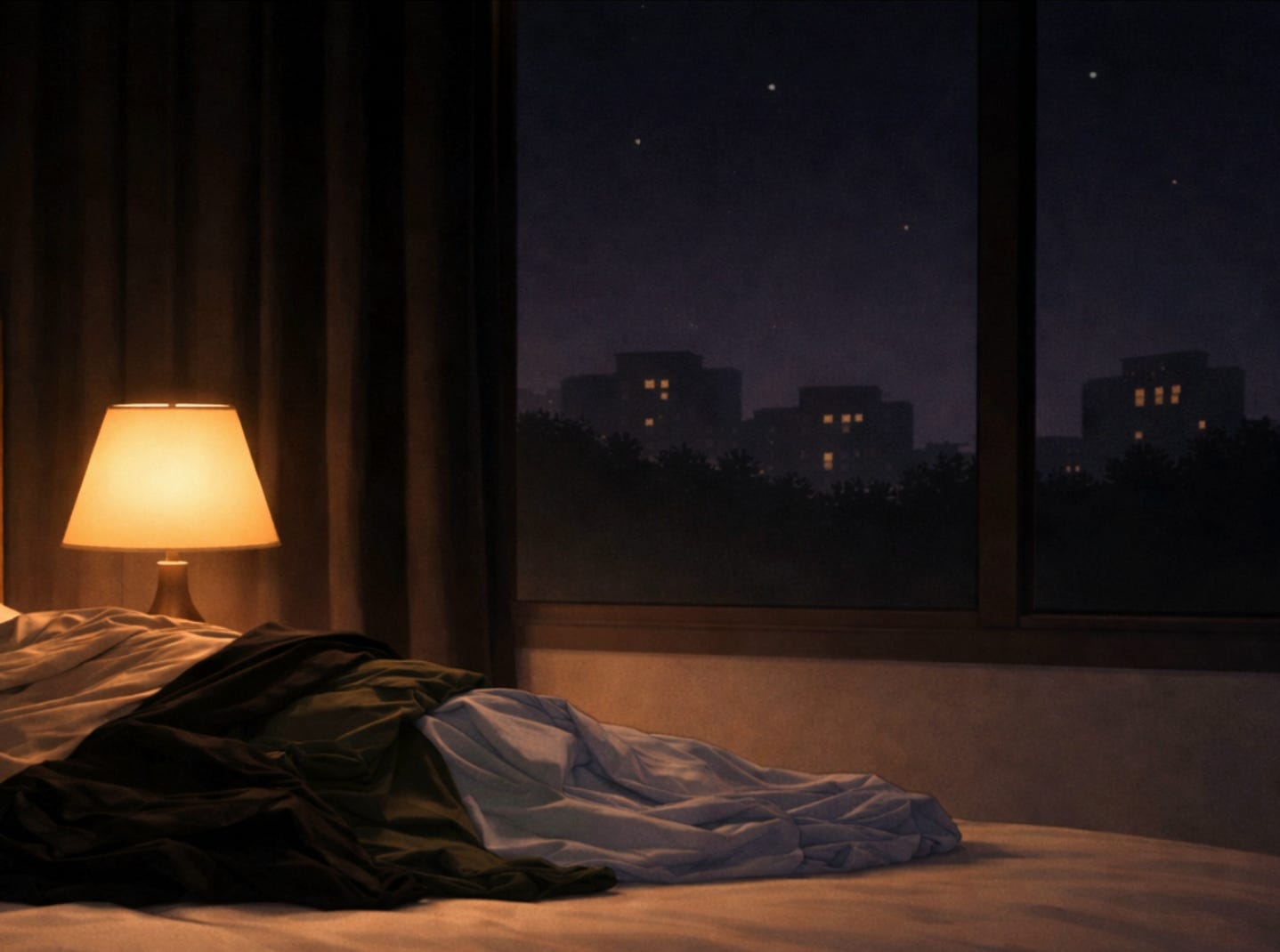
He gave the telescope away in early autumn.
There was nothing ceremonial about it. Just a text at 5:02 p.m.
“Running late. ETA 10 min. I’m in the red Subaru.”
He looked at the message for a while before locking his phone and setting it face down on the table.
By then, his supper was finished. The plate had been rinsed and left in the drying rack. A load of laundry turned slowly in the dryer down the hall. He folded two dish towels while he waited. Then unfolded one and did it again because the edges did not quite line up.
He tried to remember the last time he had made it outside to see the stars, but it had been too long. As a boy he had slipped outside late enough that his mother should have worried, though somehow she never did.
Headlights moving across the front wall brought him back to the room.
When he stepped outside, the air had already gone cool. The car that pulled up was older than he expected, road salt whitening the lower panels. The young woman who got out wore a school fleece with the county science program stitched over the chest. He recognized her from the email chain, the teacher who ran the after-school astronomy club at a rural school across the state line, south of town. Their students still had fields out there. Fewer streetlights. Darker skies.
Together they carried the long padded case down the front steps.
“Are you sure?” she asked.
He looked at the case between them, then at the fading light over the neighborhood roofs.
“It deserves clearer skies than I can give it,” he said.
The winters bit harder than they used to. The town had grown brighter over the years, too. Empty stretches had become apartment blocks, parking lots, subdivisions, pharmacies open all night. New LED streetlights bathed the roads in a harsh brightness that never really ended. Even on clear evenings the sky looked washed out.
She thanked him twice.
He told her to make sure the tripod latch stayed tight in cold weather. Told her the tracking motor was a little finicky. He told her that the first time the kids saw Saturn through it, really saw it, not in a textbook or on a screen, they would fall quiet.
Then he stood on the front walk and watched the red car pull away.
The telescope case stayed visible through the back window for a few seconds, a long dark shape among jumper cables, a tote bag, and a stack of student project boards that shifted gently as the car turned. Then the brake lights glowed at the corner. Then the car was gone.
Inside, he folded the laundry while the room dimmed around him.
A shirt. A pair of socks. Two hand towels. A pair of pajama pants gone soft at the knees.
He stacked them carefully, carried them to the bedroom, and set them on the chair he no longer needed for anything else. There was nowhere he had to be in the morning. No alarm to set. No meeting to prepare for. No pile of work that would punish him for oversleeping. He brushed his teeth, clicked off the bathroom light, and stood for a moment in the dark hall listening to the house settle.
For the first few nights, he slept straight through.
Not better, exactly. Just deeper. Cleaner.
Then, little by little, the habit returned.
Not all at once.
First it was one night a week. Then two. Then a long stretch of waking without understanding why.
At 2:13 one morning he opened his eyes and knew immediately he would not fall back asleep.
He got up to use the bathroom. The light over the sink hit him hard enough to make him squint. For a second the brightness erased everything. White tile. Tooth cup. His own face, older than he still expected it to look. He washed his hands, turned the light back off, and stood there until the dark returned in layers.
Then he made his way to the living room.
Daytime in that house had its own noise. Cars passing. Someone walking a dog. Bits of conversation drifting in from the sidewalk. A delivery truck backing up somewhere nearby. Sparrows in the shrubs. A lawnmower three houses over. But at night all of that dropped away. The whole neighborhood seemed to lower itself gently into silence. Not true silence, not completely. A furnace kicking on. The refrigerator humming. A faint creak from cooling wood. But human noise was gone.
He pulled the blinds aside and pressed close to the window.
The glass was cold enough that he felt it in his forehead first, then his cheekbone. Outside, the yard was almost featureless. A dark fence line. The vague outline of the neighbor’s shed. The black shapes of tree limbs.
At first there was nothing.
Then, as his eyes adjusted, the stars began to appear.
One. Then another. Then a faint cluster higher up, just clear enough to hold if he did not look at it directly.
He stood there for a long time without moving.
“Would’ve been a good night,” he said softly to no one.
He waited until evening to open the email, though he already knew what it would say. The planetarium would close in November.
There was no fanfare, no public statement grand enough to match the years. Just a memo forwarded by an old colleague, then an email from the campus alumni association written in careful institutional language that tries to make a loss sound procedural. Budget. Space. Future-facing development. The building would be replaced by a newer science facility, or absorbed into one, depending on which paragraph he read twice.
He stared at the screen, then closed the laptop and sat with his hands on the table. He leaned back into his chair.
The old dome had been there almost fifty years.
He had spent so many evenings under it that whole eras of his life seemed pinned to that ceiling. Graduate school. Young faculty. Public outreach nights full of restless children and patient parents. School groups smelling faintly of wet mittens. Couples falling in love on weekend programs. Retirees who asked the best questions.
He visited during the final week.
Snow had fallen the night before, the first proper snowfall of the season. Not much, just enough to cover the grass and soften the edges of the paths. The planetarium sat just beyond the far end of campus, low and round and half hidden among bare trees. Its concrete was more stained and aged than he remembered. The walkway cracked in the same places. His boots made a dry, compressing sound as he crossed the fresh snow.
Inside, the building smelled faintly of old carpet, dust, warm electronics, and winter coats brought in from the cold.
The seats still sloped upward in dark rows beneath the dome. The control console sat squat and familiar at the center, its switches and knobs dated by modern standards, almost lonely in their obsolescence. The walls were painted a deep navy that had once tried very hard to imitate the night sky and had, in low light, mostly succeeded.
People were already gathering.
Former staff. A few friends. Family members. Others from campus who had spent enough evenings under the dome to claim a piece of it. More people than he expected. More than he would have invited.
Their voices stayed low without being asked.
Someone crossed the aisle and touched his arm.
“You’re running the last one,” they said.
He let out a breath through his nose and paused for a moment.
“I guess I am.”
When everyone had settled, the lights began to dim.
The final conversations softened, then disappeared. Darkness gathered slowly over the room.
From the console, he spoke in a low, steady voice.
“Before we begin, I’d like to try something.”
A slight rustle passed through the seats.
“Just take a breath with me.”
He waited.
“Breathe in. One. Two. Three.”
The room followed.
“And out. One. Two. Three.”
Again.
“In. One. Two. Three.”
He could hear coats shifting, someone settling deeper into a seat, the collective sound of air entering and leaving bodies in the dark.
“Listen to the sound of your own breath,” he said. “Just for a moment.”
He gave them the silence.
A full minute of it.
Long enough for the darkness to settle.
Then the old projector hummed to life.
Pinpoints appeared across the dome.
Several people inhaled sharply.
“Don’t be startled,” he said, almost smiling. “That’s Orion rising.”
The stars drifted slowly above them.
A few constellations. The sky of winter. The way the eye fills in patterns of ancient hunters and goats and sisters. A cloud of dust so large that if we were inside it, it would occupy the whole sky. Distances that the mind could repeat with words but not truly grasp.
Sometimes he spoke.
Sometimes he let the stars move without interruption.
Near the end he stopped the projection on a bright point near the ecliptic.
“Saturn,” he said.
He leaned one hand on the console.
“The first time you see it through a telescope, really see it, you expect something abstract, something simple. A bright dot. Maybe a smudge if you’re lucky.”
He paused.
“And then there it is. Rings and all.”
He took his hand off the console.
No one moved.
“And for a second,” he said, “the universe becomes much bigger than your imagination prepared you for.”
He dimmed the image gradually.
“Thank you for being here tonight,” he said softly.
When the lights came back, no one spoke at first.
Then chairs shifted. People stood. Someone laughed quietly through wet eyes. Two former staff members hugged for longer than either intended. A niece or nephew, he could not tell which in the moment, came down the aisle and squeezed his shoulder without saying anything.
Outside, the cold had taken hold.
Fresh snow covered the ground in a clean sheet broken only by a few sets of tracks. The trees stood black against the night. The air was cold enough to hurt behind his eyes. He stepped carefully to the edge of the parking lot and stopped there with his hands in his coat pockets.
Above him, the stars were steady as ever.
For a long time he stood in the snow and looked up.
That night he woke again at 2:13.
He got out of bed. Used the bathroom. Blinked against the sudden light. Switched it off. Walked down the hall. Put one hand on the living room wall to steady himself in the dark.
He opened the blinds.
The window was cold against his forehead as he leaned close and waited for his eyes to adjust.
One star appeared.
Then another.
Then several more.
He watched them quietly.
And said nothing.
It comes from the telescope sitting in my closet for months at a time. From nights that looked promising until the temperature dropped too far, the clouds held on too long, the rain came unexpectedly, the snow never seemed to end, or the workday stretched later than expected. Family. Friends. Fatigue. Laundry. Dishes. The ordinary weight of a life.
Earlier this year I drafted an email to some old friends farther south, out where the skies are darker and the winters are kinder and the clouds do not linger. I stared at it for a few minutes. Thought about how they would probably get more joy out of it than I do now. Thought about the fact that I could still name all the parts by feel in the dark. Thought about Saturn and Jupiter and Orion. Thought about how many times I had already said, maybe next week, maybe when it warms up, maybe when life calms down.
Then I deleted the message.
Earlier today, while I was putting away laundry, the telescope slipped from its place in the closet and fell right to my feet after sitting undisturbed for months. I bent down, lifted it halfway out, and held its weight for a moment, just long enough to remember, before sliding it back into the dark and shutting the door.
It is not that the love is gone. I do not think that is what happens to most things we once loved deeply. I think life closes around them. The hours shift. The body changes. The cold gets sharper. Staying up late asks more than it used to. Wonder does not disappear, but it does have to compete now with work, with sleep, with errands, with other people who also deserve your time.
Maybe that is all a transition really is. Just finding yourself standing in a later chapter of life, still looking upward, still feeling the pull, but no longer inhabiting the version of life where the stars came first.
And still, on certain nights, I catch myself at the window.
I press close to the glass and wait for my eyes to adjust.
One star appears.
Then another.
And for a moment, even now, it still feels like a good night.
There’s such grace in the restraint of this piece. You capture that strange grief of still loving something deeply while no longer living in the version of life that could hold it as it once did. The planetarium scene, especially, felt luminous… it resonated a lot. Thank you for such a beautiful piece!
so beautiful, thank you for sharing 🫶🌷