
No Use Dead
A Kenshi story

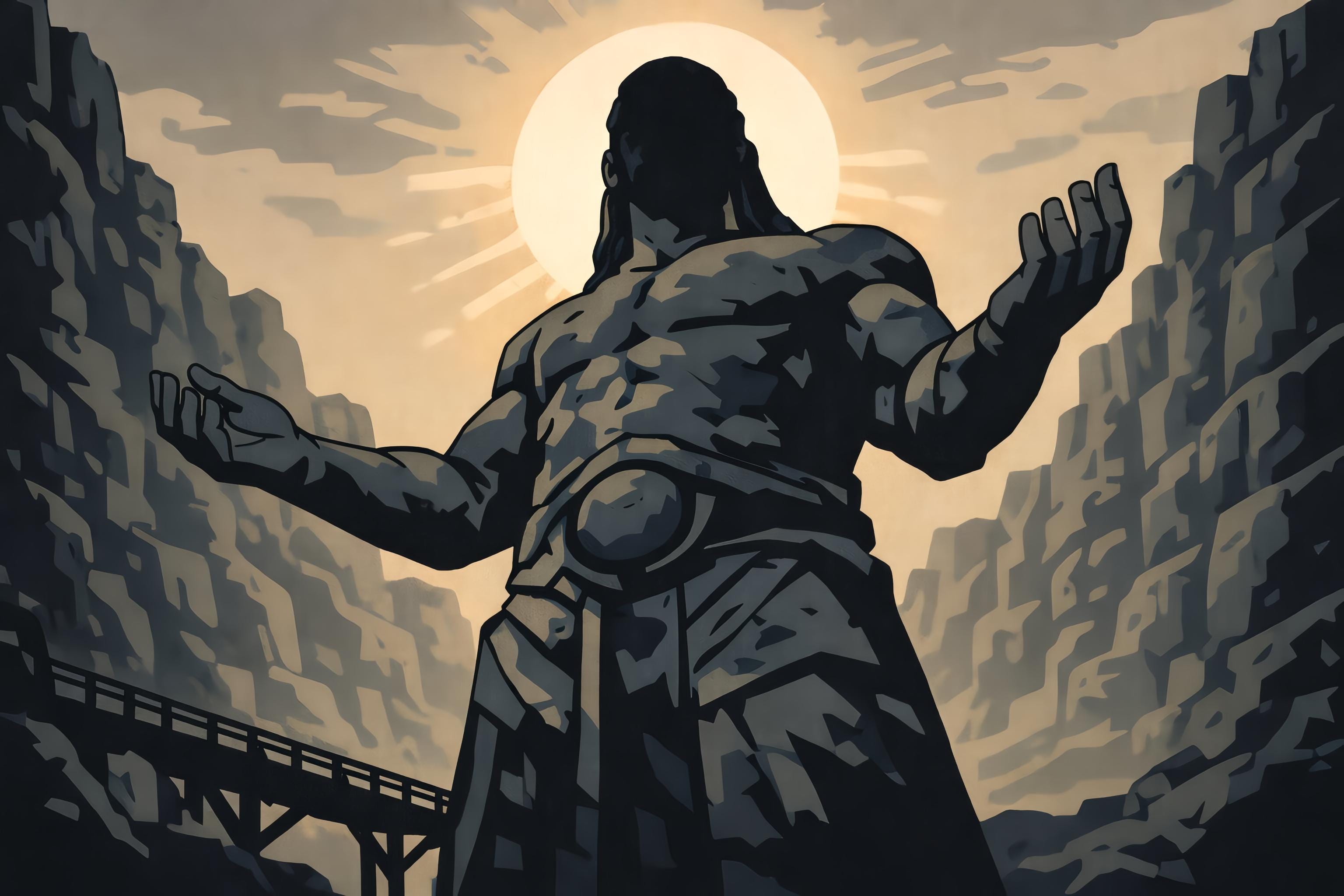
“We help them find Okran in their heart so that they can live a life of higher purpose and redemption. It is a place where they can be reborn once again, as children of Okran.”
A quote by an unnamed Holy Paladin, introducing one to Rebirth.
New here? If you do not know how we got here, start at the road:

Subscribe to get Chapter 3 in your inbox.
Content Warning: This story includes descriptions of religious extremism, misogyny, coercion, captivity and forced labor, and scenes of physical violence with brief blood and injury.
Disclaimer: This story is an unofficial, fan written work set in the world of Kenshi. Kenshi and all related names, characters, and settings are the property of Lo-Fi Games. This work is not affiliated with, endorsed by, or sponsored by Lo-Fi Games.
Sound comes back first.
Pick on stone. Chain on chain. A distant shout bounces off rock walls and returns thin and quiet. Work.
Pao’s eyes open.
They do not form a picture yet. Only light and dark. A thin strip of sky, hard white, then black bars that cut it into squares. Her eyelashes are stuck. She blinks grit. Dust stings. Her throat is so dry it feels sharp to swallow.
She tries to move.
Pain flares along her shoulder.
She jerks away.
There is a tired creak. Something old shifting under strain. A sound that belongs to weight and restraint.
When she pulls her feet in, something resists. It drags. Heavy. Uncooperative. Not part of her.
Dead weight.
Shackles.
The word arrives with the sensation. Cold ring. Rough edge. The bite where it has been rubbing, and rubbing, and rubbing.
Pao’s fingers flex.
One hand does not.
Her right hand is clenched so tight her nails cut into her palm. She does not remember making a fist. She does not remember. It is just there, locked, swollen, stubborn.
She brings it up to her face.
The movement makes her shoulder and ribs flare, and then there is a deeper ache in her stomach that is not injury. Hunger. Empty.
She forces her fingers apart.
The first finger opens with a wet crackle of skin and dried blood. The second takes longer. The third shakes. Her breath hitches and she hates the sound of it, small and weak in this place.
Something presses against her palm.
Warm metal.
A coin.
Its face worn smooth.
It is still there.
She had pressed it into Hand’s palm once, joking.
“For luck,” she’d said.
Hand had pressed it back.
“We make our own.”
Now it is warm and slick with her palm.
Pao swallows. It hurts.
Her lips are cracked. Her tongue feels too big for her mouth. She tastes rust.
She looks down at herself.
Orange.
This is not the robe from the road. Not like the one she saw with Brother Jera.
This cloth is heavier. Rougher. The dye is dark, almost red in the shade of the cage. It scratches her neck. It reeks of old sweat. It hangs wrong, thrown onto her without care. The knot is on the wrong side. Too tight. Twisted. Like someone else tied it while she was dead weight.
Her scalp is cold.
She lifts a hand and touches her head.
No hair.
Her fingers slide over stubble. Over tender skin. Over a faint line where something scraped too hard.
The missing time opens in her mind like a hole.
The road. Torchlight. Guards. Blood. Hand. The men who laughed. The way the world tipped and went black.
Then this.
New clothes. No hair. Shackles. A cage.
Her stomach turns.
Fear narrows her sight to bars and hands and the next breath.
Somewhere in the gorge, rock falls. A small collapse. Stones tumbling. The sound echoes, slow and heavy, and Pao feels it in her teeth.
She cannot stay here with the coin in her hand.
If a guard sees it, it is gone.
If the coin is the last small thing that belongs to her, that she can hold onto, then she has to hide it where eyes do not go.
She shifts carefully, dragging her shackled feet. The weight is ridiculous. It drags on her like a boulder.
The cage floor is stone and dust. There is a base plate, a flat strip bolted down, with grit packed around its edge. Someone has tried to pry it before. The corner has a slight gap where the dust collects.
Pao scrapes with her uninjured fingers.
Dust. Sand. Small rocks. Her nails break dirt loose. She works without looking up, because looking up feels like asking to be noticed.
She slides the coin into the gap. Presses it down until it clicks against metal. Then she shoves grit on top. Stones. Sand. Dust. She pats it down.
Her hands tremble when she pulls away.
She presses her injured fist to her chest and breathes.
Her eyes finally begin to see properly.
The gorge is vast and narrow. Rock walls rise on both sides like a corridor of giants. The sky is a thin ribbon. The light is sharp when it hits.
The camp is carved into the gorge like a scar within a scar.
Cages. Posts. Work lines. Scaffolds.
A tower half built, its frame sticking up like ribs. A squat building near it with smoke stained stone and a door that opens and closes with guards moving in and out. Lodging. Storage. A place where the holy sleep while the unholy work.
Patrols move through it in loops. Not many, but enough. Enough because the gorge itself is a fence.
Pao looks for Hand.
She does it on instinct.
She scans the nearest cages. Faces. Shapes. Bodies slumped against bars. She sees a boy who looks too young. She sees a man with a swollen eye. She sees someone staring at nothing like their mind has already left.
No Hand.
Pao’s throat tightens. Her heart pounds once, hard, like it is trying to escape.
She presses closer to the bars.
The metal is hot in places where sunlight reaches it. It sears her forearm. She pulls back and the skin feels raw.
“Hand,” she tries to say.
Only air comes out. A rasp. A cracked whisper. Her throat is too dry to form anything clean.
A shadow passes.
Boots on stone. Cloth brushing. The sound of a weapon tapping against bars.
A guard pauses at Pao’s cage.
Pao’s body locks up.
The guard’s face is young. Too young for the certainty in his eyes. He looks like a temple painting of some bright boy saint, all clean lines and righteous jaw.
His hair is neat. His armor is oiled. His expression twists when he looks at the prisoners, like he has just smelled something rotten.
He turns his head away from her. Spits.
The spit hits stone and turns dark.
He does not look at her again. He reaches down and tosses something through the bars.
A small waterskin.
It lands near Pao’s feet.
No words.
The guard wipes his hand on the rock as if the act itself has dirtied him.
Pao stares at the waterskin.
Her mouth aches.
She crawls toward it. The shackles clink and scrape. The weight makes her movement slow, ugly, humiliating.
She grips the waterskin and pulls it close.
She smells it first.
Stale water. Old leather. A faint tang of something that might be sweat.
She drinks anyway.
The first swallow burns. Her throat screams. The second is easier. The third makes her stomach cramp.
She stops. Saves it. Clutches it like it matters.
The same guard meets another guard at the cage line. One lifts his hand, fingers spread like rays. The other taps his own chest and answers without looking at the prisoners.
“Praise the light.”
The phrase ripples down the cage line.
A rod taps iron. Once. Twice.
“Praise the light,” a guard calls again, louder.
Prisoners repeat it, uneven, late, forced.
Pick strikes answer it from the work line.
On the guards’ belts, a sunburst stamp catches the light. Simple rays. Clean. Everywhere.
A shout cracks through the gorge.
“Move.”
Another shout answers it.
“Faster. Eyes down. Work.”
A scream rises, thin and sharp, then stops.
Pao’s eyes snap toward the sound.
Across the camp, a prisoner is on their knees. A guard stands over them with a rod. The rod comes down. The prisoner’s body jerks.
Again.
Again.
The guards do not hide it. They do it where everyone can see.
Pao’s stomach flips.
She grips the waterskin harder.
She thinks of Brother Jera’s smile. Clean. Practiced. The little nod. The way he spoke about purity like it was a gift.
This is what purity looks like.
A rod. A knee. A mouth that stops screaming because it has learned it does not matter.
Pao presses her back against the far side of the cage and tries to breathe quietly in the shadow.
Pao will not beg.
Time passes.
The sun moves.
For a few hours, direct light pours into the gorge like molten metal. It hits the cage bars and makes them blistering hot. It hits Pao’s skin through the cloth and makes her sweat, and the sweat has nowhere to go.
A prisoner in the next cage shifts his body to block a sliver of sun. Another leans toward him, desperate.
A waterskin tilts. One swallow. Payment.
The shaded man turns his shoulder, just enough to share the dark.
No thanks. No words.
Pao watches and understands. Even mercy has a price here.
The sun does not care about bargains.
It keeps moving.
Light crawls down the bars inch by inch. The shadow shifts. The borrowed dark disappears.
By the time the last strip of shade reaches the floor, the heat has already begun to retreat.
Then the light slides away.
Shade comes back. The gorge cools fast.
No one comes for Pao.
No one tells her anything.
She is left in the cage, alone, broken.
When night comes, the camp does not become quiet.
Torches flare. Shadows sharpen. The statue becomes a black shape against the sky, even bigger when the dark erases its edges.
From her cage on the gorge floor, she could only ever see a slice of it. Bars and cliff walls cut the sky into narrow frames. The rest was hidden behind stone and scaffolding.
Now, with the light low and the shadows long, the whole shape pulls free of the glare.
Pao sees the statue properly for the first time.
It is enormous. It scrapes the sky.
A figure carved in stone, rising out of scaffolding like it is being pulled from the earth. It has arms. It has a face. Its posture is an order.
At its waist, a sunburst is carved into the stone. Rays like knives.
The same mark sits stamped on guard buckles and breastplates.
They are building a god in their image.
The details are exquisite. Chisel marks. Veins of stone. A fold of carved cloth that looks soft if you forget what it is made of.
It is unfinished, but it already dominates the gorge.
The camp is built around it the way a town might be built around a temple.
Pao stares until her eyes burn.
She wants to ask what it is. She wants to ask why. She wants to ask how long.
But she remembers the rod. The kneeling body. The scream that stopped.
She swallows the questions.
Her stomach cramps again.
Hunger is a steady animal. It circles relentlessly.
Sleep comes in broken pieces. Pao’s body collapses because it has to.
She dreams of the road.
She dreams of the farm.
She dreams of the coin rolling across Hand’s knuckles, warm metal, erased face, and then she wakes and it is stone dust and bars and shackles and the sound of work starting before the sky is even light.
A bell rings.
A hard metal clang that says, up.
The cages are opened one by one.
Guards walk the line with rods and keys. Shackles clink. Prisoners stumble out like animals learning their legs again.
Pao tries to stand.
The shackles drag her feet down. The weight changes everything. She used to walk. She used to run. She used to choose where her body went.
Now every step is a struggle.
A guard grabs her arm and yanks her into a line.
Pain flashes down her hand. Her injured fist clenches harder.
“Move,” the guard says.
His voice is not loud. It does not need to be. It is backed by the whole camp.
Pao moves.
The line shuffles forward. Heads down. Eyes lowered. The shackles carve grooves behind every ankle, twin furrows in the dust. The gorge smells like dust, sweat, and piss baked into stone.
They march past the cages. Past the tower. Past a corner where one guard pauses, turning his head away from the prisoners like they are a sickness. He spits. He pisses on the rock. He wipes his hands on the wall. Habit. Disgust. Small filth from a man who believes he is clean.
Pao sees it and her lip curls before she can stop it.
The guard does not notice.
He is too busy not looking at her.
Pao’s gaze slides sideways for a heartbeat.
A guard behind her snaps, “Eyes forward.”
Pao jerks her eyes forward.
Not yet. Not here. She does not know enough to fight.
The guard’s voice softens.
“With hard work, blood and sweat,” he says, “you can still redeem yourself.”
He says it like he is offering water.
Pao bites the inside of her cheek until she tastes blood.
Work begins.
Mining by hand.
Pickaxes hitting stone until arms shake. Hauling rock in baskets. Carrying carved blocks toward the scaffolding. Dust coats everything. It sinks into sweat and stays.
The shackles make every movement slower. They drag. They scrape. They catch on stone. They make you clumsy. They make you visible.
Pao sees other prisoners stumble and get struck for it.
A guard pauses beside a man whose pile is higher than the others.
He lifts the man’s chin with two fingers.
“See,” he says. “Redemption.”
He tilts a waterskin to the man’s mouth. One long swallow.
The space around the man widens.
By midday, Pao’s muscles are shaking.
Her stomach hurts with hunger so hard it becomes a different kind of pain. A pain she can almost ignore because everything hurts.
When the work bell rings again, it is mercy. It is an instruction. Shift. Move. Keep going.
At night, when the camp settles into its different rhythm, Pao’s mind starts wandering.
It searches for exits.
It searches for patterns.
It searches for any small thing that can become leverage.
Her eyes keep returning to her shackles.
The lock face is small. Smooth. Metal worn by other hands trying the same impossible thing.
She studies it like a starving animal studies bone.
Too thick. Too tight.
She shifts closer to the bars.
Slowly, carefully, she threads the chain between two of them and pulls back.
The links snap straight. Iron presses hard into bone. The bar does not bend. The cage answers with a low complaint, metal against metal.
She plants her feet and leans her full weight away, using the bar as an anchor. The ring at her ankle grinds. Skin tears a little. She tastes copper in her mouth though she does not know why.
Nothing gives.
She changes angles. Hooks the chain higher. Pulls again. Harder.
The only movement is her own body shaking.
The iron remains patient. Unmoved.
She stops when her breath turns ragged.
Her body understands. She is not built to break this.
Still, she keeps her hands on the chain a moment longer, as if warmth alone might soften it.
Her arms begin to tremble. The shaking will not stop.
She lets the chain fall slack.
The cage goes quiet again.
There is nothing left to do but listen.
She waits until the night is deep.
Until the torches burn lower.
Until the patrol loop passes and the sound of boots fades down the gorge.
Then she shifts her shackled feet close.
She pulls the coin from its hiding place, fingers scraping dust, heart racing. She wipes it on her robe. The coin leaves a dark smear.
She presses the edge of the coin into the lock.
It does nothing.
She presses harder.
The coin slips and bites her skin. A sharp slice. Then a warm line of blood.
Pao inhales too fast. The sound is loud in her own head.
A voice cuts through the dark.
From a cage nearby.
“Are you kidding?”
Pao freezes.
She looks sideways.
In the dim, she sees another girl. Skin black as pitch. Shaved head like Pao’s. Eyes that catch light like polished wet stone. Her posture is hard, defensive, like she has been forced to become an object that does not break.
The girl’s voice is low and contemptuous.
“A coin,” she says. “That’s your plan, a coin?”
Pao’s cheeks burn.
“Quiet,” Pao whispers without thinking.
The other girl snorts.
“Quiet,” she repeats, like the word itself is stupid. She coughs out a half laugh. “Soft hands,” she says while scoffing. “You’re bleeding. Stop. You want them over here?”
Pao presses her injured hand to her chest. Blood smears her robe.
She wants to ask who the other girl is. She wants to ask how long she has been here. She wants to ask if she has seen Hand.
Names and words rise in her throat like panic.
She swallows them.
A shadow moves.
Boots.
A guard’s silhouette crosses the torchlight.
The guard pauses between cages.
He barks, “Which one of you.”
No name.
No interest in identity.
Only submission.
Pao’s breath locks.
She can point.
She can tilt her head.
She can give the guard a direction, any direction, and maybe the rod goes somewhere else.
The coin in her hand feels heavy. The blood on her palm feels hot.
The other girl says nothing.
Pao says nothing.
The guard’s boots shift.
His rod taps bars.
“Who was it?”
Pao keeps her eyes on the floor.
The guard’s rod strikes the bars again, harder.
Pao does not flinch.
A beat.
Then the cage door opens.
Arms seize her.
Rough. Fast.
She is dragged out like a sack.
Stone scrapes her knees. The shackles clank and catch, and the arms do not care, they just yank harder.
Pao tries to hold her injured hand close to her body.
A guard catches her wrist and twists.
Pain explodes.
The coin drops. It clinks against the bars and bounces back into the cage, into shadow. She sees it for a blink, safe behind iron.
She is hauled into the open.
Torches glare.
A rod comes down.
Once.
Twice.
The blows land where they want, shoulders, ribs, back. Pao’s breath empties in a sound she hates. A small animal sound. A sound that makes her feel less human than the shackles do.
Her vision tunnels.
The gorge swallows sound and gives it back distorted.
Guards continue. The schedule keeps going. Boots. Keys. Rod. Boots. A cough behind armor. A belt buckle snap. A voice reciting the same words to the next body.
Pao’s knees buckle.
The last thing she hears is the girl’s voice, faint, not kind, not soft.
“Idiot.”
The world tilts sideways.
Stone against her cheek.
Dust in her mouth.
The gorge keeps moving.
Pick. Chain. Shout.
Work is starting.
Pao’s eyes open and the ground is cold under her cheek. Her face is pressed into dust. Her tongue tastes stone.
She tries to lift her head.
Her neck screams.
Her body screams.
Her ribs hurt when she breathes. Her back hurts. Her hand hurts in a deep, pulsing way that makes her want to vomit.
The bell rings.
Someone drags her up.
“Move.”
Pao staggers into the line like a drunk.
No one pauses. The line moves without regard to her. The bell comes anyway.
The other girl from last night is in the line now too, close enough that Pao can hear her breathe.
The girl shifts her weight.
“They beat you,” she says, voice flat, eyes forward. “Work’s starting. Move when they say.”
Pao wants to answer. Wants to spit. Wants to cry.
Her mouth opens and nothing useful comes out.
She moves.
Morning inspection happens after the first work assignment. Guards walk the rows. Fast. Thorough. Not interested in detail, only defiance.
A guard stops at Pao’s shackles.
She pinches her sleeve over the cut on her finger and holds her hand under her thigh. Head down. Shoulders loose. Like nothing happened. Like her body is not a problem to notice.
He crouches and runs a finger over the lock face.
His finger comes back red.
Blood.
He looks up at Pao like she is a problem, not a person.
He stands.
He does not hit her. Not yet.
He simply walks past her when food is handed out later.
Pao watches the bowls pass. Thin gray porridge with grit at the bottom. It smells like wet flour and old metal. The smell of it makes her stomach twist.
When the guard reaches Pao, he does not slow.
He does not look at her.
He keeps walking.
The missed meal is silent. Public. Targeted. Cruel.
Pao’s hands shake.
Her injured fist clenches.
The other girl does not look at her.
She does not offer Pao any pity.
Work lasts longer that day.
The bell that usually marks rest does not ring when it should. Or it rings, and nothing changes.
They missed quota.
Pao hears it in passing, not meant for her.
“Short on stone,” a guard says. “Short on blocks.”
Another guard answers, bored. “Then no rest.”
The guards keep them moving. The gorge keeps swallowing the hours.
Pao learns what those longer hours feel like.
It is not dramatic.
It is grinding.
It is her arms shaking and still lifting.
It is her legs numb and still stepping.
It is her mind floating away and being yanked back by a shout.
It is learning that pain is not the end of anything here.
Pain is normal.
Near the end of the second day, Pao is moved with a hauling line past the statue.
Close.
So close she can see the grains in the stone.
So close she can see the half carved face, serene, commanding, unbothered by the ants at its feet.
Pao’s head tilts up before she can stop it.
She is starving. She is exhausted. She is bruised and shaved and shackled. She should not care about a statue.
But it is so huge it feels like it is pressing down on the gorge.
It feels like a god built from rock, ready to crush them all.
Pao stares.
A guard shoves her.
Hard.
Her shoulder hits another prisoner. The prisoner stumbles. Shackles clatter.
“Eyes forward,” the guard snaps.
Pao drops her gaze.
But the question is already in her mouth.
“How long,” she whispers.
The guard either does not hear or does not care.
The other girl hears.
The girl’s voice is low. Flat. Like she is reciting a fact.
“Forever,” the other girl says.
Pao swallows.
“How long have they been building,” Pao whispers.
The other girl’s mouth twitches. Not a smile. Something sharper.
“Since the beginning,” she says.
No explanation.
Just a phrase that sounds like another wall.
That night, Pao does not try the lock again.
She watches.
She counts footsteps when patrols pass.
She learns the disgusted guard’s habits. The corner where he always stops to piss. The way he turns his head away from the cages like the sight of them offends him. The way he wipes his hand on stone after touching anything near prisoners.
She learns of their blindness. The guards look for what screams defiance. If you keep your head down and your hands empty and your lock clean, they move on.
She learns the human weakness loop. A smoke break. A prayer mutter. A gear adjustment. Same place. Same time.
The girl watches her.
This time, she does not look away when Pao catches her.
Something shifts behind her eyes. Not softer. Sharper.
On the third day, the work line changes.
Pao is moved.
Not far, but enough that she can see the upright posts near the base of the statue more clearly.
They stand in a row like stakes.
Prisoners are chained to them upright, arms above their heads or behind them, bodies slumped forward, heads hanging. Some are asleep standing, their bodies forced into it. Some are awake, eyes empty, mouths cracked.
It is punishment in full display.
Terror scheduled and hung where everyone must pass.
Pao’s chest tightens.
She scans the posts without meaning to.
Faces.
Bodies.
Shaved heads.
Bruises.
She cannot recognize anyone. Everyone looks like everyone when the camp has scrubbed them down to the same raw thing.
Her eyes keep searching anyway.
Her mind keeps whispering, Hand.
Hand.
Hand.
The girl from before is beside her. She says nothing.
At night, they are driven up onto the roof cages.
A low stone building sits under them, smoke stained, loud with doors and boots. The guards stay inside it, first floor, out of the wind. If you are not worth watching, you go on the roof. They do not walk the roof unless someone makes them.
Up here, the cages are bolted to stone like scrap. Not a single spot of shade, or walls, or privacy. Just bars and height.
The gorge opens below, work lines, posts, the statue’s black shape eating the last of the light.
Voices from below drift up thin and broken. Wind takes the edges off everything.
Chains clink softly as bodies try to find a position that hurts less.
The girl in the next cage shifts. She turns her head just enough to look at Pao.
It is the first time she looks directly.
“You can keep your mouth shut,” she says, eyes fixed on the statue below.
Her voice is still detached, but something in it has moved.
Pao’s throat tightens. She does not answer.
The girl exhales through her nose.
“I know who you’re looking for,” she says.
A hiss from another roof cage. Not a guard. A prisoner.
“Plop. Shut it.”
The name lands like a bruise. Used before. Used often.
The girl does not look away from Pao.
Pao’s whole body goes still.
“I worked beside her the first day you two came in together,” Plop whispers.
Pao does not move.
“She screamed for you. Loud. Wouldn’t stop.”
A pause.
“They dragged her off for it.”
The gorge breathes around them.
“I didn’t know if you were the same,” Plop says. “If you’d start shouting too.”
Another breath.
“You didn’t.”
Silence stretches.
“Camp doesn’t need two of you breaking at once.”
Her gaze never leaves the stone god as she says it. The contempt thins, just a little.
“She’s still got teeth.”
Another beat.
“Figured you’d want to know.”
The camp sound seems to pull back. Like the gorge is holding its breath.
Plop lifts her chin toward the dark.
“Over there,” Plop says. “Poles.”
Pao leans forward until her face is near the bars.
Her eyes strain.
A brazier burns near the posts. Not for the prisoners, for the guards. It throws a low orange light that makes bodies look like carved stone.
Pao squints until her eyes water.
She sees the rows.
She sees the slumped bodies chained to them.
She sees one shape that looks smaller than the others.
A shaved head hanging forward.
A face swollen wrong.
Blood dried dark on skin. Dirt caked into it. Bruises layered on bruises until the body looks carved out of pain.
Her eyes open a crack.
For one second, she looks straight at nothing, then her mouth twitches.
That same almost smile. The one that used to say, I am still here.
Pao’s hand rises to her mouth without thinking.
Her injured fist trembles.
She cannot recognize Hand by face.
She cannot recognize Hand by hair.
The camp has taken those.
But there is something in the posture, in the way the shoulders slump, in the way the body is holding itself as if it is trying to disappear, and that smile.
Then the chest rises.
Barely.
A shallow pull of air.
A breath.
Then another.
Hand is breathing.
Pao’s eyes burn.
Tears come anyway, small and hot, and she hates them because they are a weakness, and she cannot stop them because her body does not care what she hates.
She does not speak.
She does not call out.
She does not say Hand’s name into the gorge where it can be heard and used and punished.
She only watches.
She only counts the breaths.
One.
Two.
Three.
Alive.
At least she is alive.
The camp continues its quiet night noises.
Chains creak.
A guard coughs somewhere.
Stone dust falls from high scaffolding like slow snow.
Pao keeps her eyes on the poles until they blur.
She watches the chest rise.
Fall.
Rise again.
A small impact against her ankle.
A stale crust lands near her foot.
Thrown.
Pao looks up.
Plop does not.
“Don’t waste it,” she says. “You’re no use dead.”
If you are still here, subscribe. The next chapter is coming.
"You're no use dead." Four words that carry the entire moral logic of survival in this world. The coin as both object and symbol is beautifully handled and Plop is a genuinely compelling character built in almost no space at all.
Great to have your voice here on Substack, Steven. Subscribed and look forward to reading more. I would love you to do the same, if my writing resonates.
Any friend of Kenshi is a friend of mine. Subscribed.