
The Encyclopedia Years
A personal essay on childhood curiosity.

In the basement of my grandmother’s house, in a small town in the Minnesota River Valley, there was a storage room with a low ceiling and a sliding accordion door. The floor was bare concrete. Cold even in summer. The rafters showed overhead. Boxes of old papers sat beside holiday decorations and forgotten toys. On the top shelf in back stood sixteen hardcover books in solid colors, a rainbow from A to Z.
They were The Golden Book Encyclopedia.
I was seven or eight when I started pulling them down. I had no system. I did not begin with A. I did not work forward in order. I took one at random because I did not know where else to begin.
I would carry a volume into the next room and sit on my grandmother’s couch with it open in my lap. The basement was quiet. Not dead quiet, but house quiet. A low hum somewhere. The yellow light from old bulbs. The couch fabric itched. The pillows itched too. I learned to spread a blanket between my skin and the cloth, then settle in and read until the afternoon was gone.
My grandmother never said much about it. She was upstairs or elsewhere in the house, cooking lunch, reading the paper, folding laundry, moving through the work of a day. It was my mother’s childhood home too. That house had already held one generation of children before me. Maybe more, if you count all the cousins and all the summers and all the days that settled into the walls.
Down in the basement I could open a random volume and step out of the room.
One entry stayed with me longer than the others.
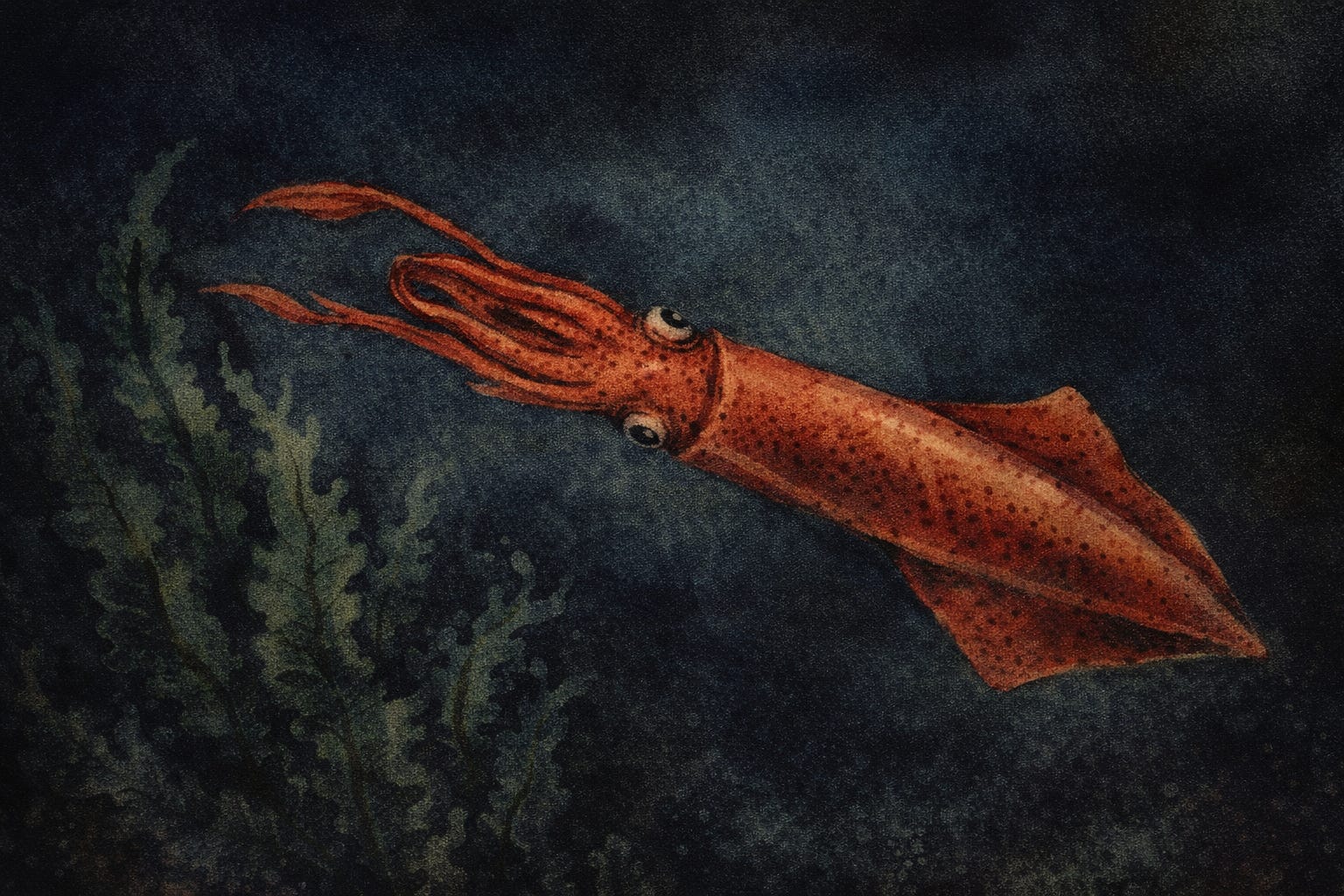
Squids.
At least that is what I remembered.
For years I carried around the sense that one of those books had given me giant squids. Not just squids. Giant squids. Sea monsters. Something vast enough to live in the same mental waters as shipwrecks, abyssal dark, and old sailor tales. In memory that page had the grandeur of an adventure cover, something between 20,000 Leagues Under the Sea and a warning from long dead sailors. I remembered the creature as huge. Dark. Almost mythic.
It lived in the same part of my mind as the Bermuda Triangle.
On Friday nights I would sometimes fall asleep on the couch in our own basement with the television turned low. Our basement was finished, not like my grandmother’s storage room. White walls. More windows. More comfortable furniture. Worse at holding warmth. In winter the cold came in slow through the glass and settled across the room. The TV flicker hit the walls and made the whole basement glow at night. I would lie there half awake, half drifting, while some narrator spoke of vanished planes, strange lights, lost ships, old mysteries, things swallowed by sea or sky.
A room below ground. A screen. A voice. The world is wider than you think. The map is not finished. There are still blank places.
Years later, while trying to write about those old encyclopedias, I tracked them down online. I found the series. The Golden Book Encyclopedia. My mother had used them for homework in the 1970s. I went back looking for the squid entry first.
Of course I did.
The page was smaller than I remembered. Gentler too. The drawing was made for children. The prose was simple. My own kid could probably read it without much trouble.
And there was no giant squid there.
At some point my mind had pulled together a children’s encyclopedia, television mysteries, ocean lore, half heard facts, and whatever else a child collects, and stitched them into one creature. The page itself had not held everything I remembered. Memory had done its own work. It had made its own world from fragments.
Those books gave me something, even if it was not the exact monster I remembered. They taught me that knowledge is a doorway. Facts are not dead things. A squid opens into deep water. A city opens into another century, another language, another world. A map or a paragraph could make the room I was sitting in feel larger.
That habit showed up in other places too.
I think the math may have come before the books. I remember walking down the school hallway in kindergarten with my older sister one morning before class. She was several grades ahead of me. I asked her what multiplication was. We had not learned it yet. I was not asking for help. I wanted to know what came next.
That question belonged to the same world as the encyclopedias.
What else is there. What am I not seeing. What lies just past the edge.
Teachers noticed. My mother noticed. I ended up in advanced math. Extra packets. Scantrons during breaks. More problems. More steps. More numbers. I moved fast until I hit estimation, and estimation stopped me cold. I argued with a student teacher because I could not understand why I would estimate an answer if I knew how to get the real one.
I was stubborn. Too literal too, probably.
But the skeleton of it was already there. Curiosity was more than wonder. It was insistence. I did not want approximations. I wanted the answer.
That habit moved outside books and numbers.
My mother gave us room to roam. I think about that now and do not know how she managed it with four kids. We camped. We went to the lakes. We visited museums. We cut down Christmas trees. We went on field trips. We were allowed to climb and wander and get dirty and look closely at things.
One of my early memories is the woods behind the house where I grew up. There was a half fallen tree with a giant rock at the base, and if you used the trunk right you could shimmy up into another tree, maybe fifteen feet off the ground. Sometimes we did it after rain, when the bark was slick and the moss made the whole thing dangerous. Wet hands. Mud on shoes. The smell of leaves and dirt and broken wood.
You climbed anyway.
Then there was the night we slept with the dinosaurs.
We spent the night under the exhibits. I still remember the scale of it. The museum darkened down. The skeletons overhead. The long shadows. The carpeted floor under sleeping bags. The sense that the room had slipped out of ordinary time. It felt cinematic, yes, but that is too light a word for what it was. It felt older than that. Older than movies. Older than stories. Bone and scale and extinction hanging above a room full of kids trying to sleep.
If the encyclopedias taught me that the world was large, nights like that taught me it had always been large. Large before me. Large beyond me. Large in directions I did not yet have words for.
Eventually the basement shelf gave way to other portals. School libraries. Big science books. History books. Discovery Channel. Wikipedia. YouTube. Pages leading to pages. Links leading to links. One afternoon going under and another taking its place. You could enter almost anywhere and keep moving until the light outside changed and the day was gone.
For a long time I did not think of this as a skill. I did not think of it as much of anything. It was simply the way my mind moved. I liked facts. I liked patterns. I liked seeing the connections. Only later did I understand that this habit had been shaping my life the whole time.
In adulthood, once I started working in a corporate environment, I kept asking why. It was never enough to be told this is the process or this is what we do. I pushed. Why this way. What connects to what. If this piece fails, what breaks next. That habit opened doors. It moved me into new roles. It led me toward risk management, where the work is tracing connections, finding weaknesses, and spotting problems before they surface.
It is not a bad job for someone who grew up pulling random volumes off a shelf and looking for monsters.
Curiosity sounds admirable from a distance. Up close it can look more like restlessness. Or compulsion. One more tab. One more question. One more volume. One more missing piece. Delight and compulsion are closer than they look. Two faces on the same coin. Two doors opening into the same room.
A few months ago, while trying to write this essay, I asked my grandmother whether she still had those encyclopedias.
She did not.
She had thrown them away.
I sat with that for a while. Then I talked with her. Talked with my mother. Pieced it together. Found the books again in another form. Screens instead of paper. Search boxes instead of spines. I spent an evening looking through entries and covers I had not seen in decades.
The detail was wrong. The feeling was not. I did not remember the page exactly. I remembered what it did.
It took a child in a basement in Minnesota and convinced him that the world was larger than the room he was sitting in. Larger than the town. Larger than the valley. Larger than whatever adults had already named and sorted and shelved. It taught him that a few sentences and a drawing could open onto weather, distance, history, myth. It taught him that the known world always casts a shadow, and that shadow is where the next question waits.
The room was small.
The shelf was small.
The page was smaller than memory.
But the world it opened was not.
I lived in ND so I know those winters can be long! Good thing you had your love of learning and imagination!
Loved this. I had the same experience at my grandmother’s house. I read all of her books when I finished my own. Memory is a powerful thing that often blurs lines with imagination.