
Weird Tales Then and Now
How Speculative Fiction Pulled Me Back

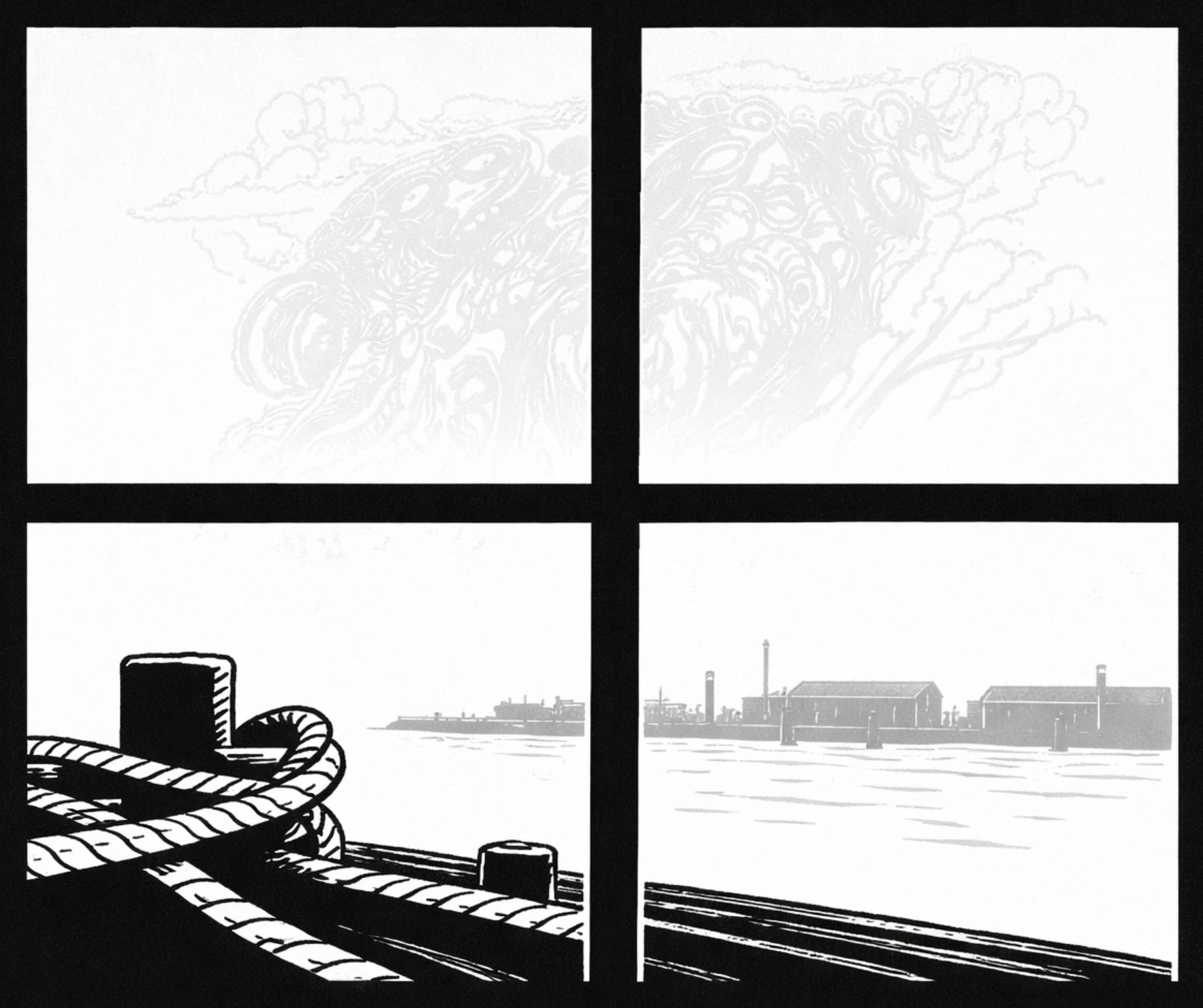
For a long stretch of my childhood, I drifted away from reading. Video games were faster. Louder. More immediate. They gave me worlds without effort.
It was not until my junior year of college that I stumbled back into books by accident. I was digging through storage at the game shop where I worked, moving old stock, half paying attention. That is when I found it. An old paperback. Destination Void by Frank Herbert. The cover art stopped me first. Stark. Strange. Aggressively science fiction.
I took it home.
It felt different from everything I had been consuming. Slower. Denser. Demanding. The cover had history, it had age. It did not glow. It did not scroll.
And somewhere halfway through, I realized it was not even the plot that had me. It was the tone. The scale. The seriousness of it. I put the book down before I could finish it and went looking for more of that feeling. I wanted the entire style.
So I dove headfirst. Ringworld. Dune. Neuromancer. One after another. Old covers. Big ideas. Worlds so large I could barely keep up.
After that, I started walking backward. I widened out into speculative fiction and chased the roots. Frankenstein. Dracula. Then Lovecraft, when the fear stopped being a creature and became the universe itself.
That rediscovery in the storage room did not just pull me back into reading. It reopened something I thought I had lost as a kid, the feeling of holding a world in my hands.
I think about that a lot when I think about early pulp magazines. About dime racks. About the first time someone picked up Weird Tales and saw a name like H. P. Lovecraft printed in bold type.
I wonder what it felt like to choose a story all of those years ago.
It is a brisk April morning and the river air carries up through the streets.
I am at the docks. Rope in my hands. Coffee sacks stacked high, the burlap rough and damp, a little grit working loose onto the planks. A horn out on the water, low and steady. Men calling to each other over the noise.
A sack slips and the foreman shouts without thinking. “We’re not loading air, pick it up.”
I get it back on my shoulder and feel the rope burn across my palm. It has been there since yesterday. It stings when I tighten my grip.
Near the end of the shift I get a tap on the shoulder. Another worker leans in close and tells me we are cutting short today. Half day. Word travels fast. Men start untying aprons, wiping hands, looking toward the gate.
A few minutes later we funnel toward the time clock in a loose clump, a few dozen of us. Caps. Work coats. The sound of boots and tired talk. A couple guys make jokes that do not really go anywhere. Mostly we just want out.
The union man comes through with the time cards. He signs off on the early release and hands mine back. I feed it into the clock and the machine bites down and stamps it hard.
I am relieved.
Not because I hate work. Because it is my daughter’s birthday. My wife has been planning all week. She could use the help when I get home.
I rinse my hands in cold water that never really gets the dirt out. Dry them on my trousers anyway. Grab my cap and step out into the street with the rest of them.
The city is busy. Streetcars rattling. Horses moving slow. People packed along the sidewalks, shoulders brushing, nobody stopping. The river smell comes and goes between buildings.
I pass a tailor shop window. Suits lined up clean behind glass. The kind I will never buy.
A man bumps my shoulder and keeps going like I was not there.
A woman drops a parcel right after that. I stop and pick it up, hand it back. She thanks me quick and disappears into the crowd.
Right before the newsstand there is a small candy shop. I walk past it, then stop and step back. I check my pocket again. I think about the party. I think about my daughter.
I go inside anyway.
It is not fancy. Just a counter, glass, and a man behind it. I rummage through my pockets and find my nickel. I ask what a nickel gets me. He slides me a Baby Ruth bar in wax paper and takes the nickel like this is the most normal trade in the world. I tuck it into my coat pocket.
When I step back onto the sidewalk, a headline board catches my eye at the corner.
PROHIBITION RAID NETS DOZENS.
EUROPE STILL RESTLESS.
Then I reach the newsstand.
Newspapers stacked high. Ink smell. Damp paper. Yesterday’s paper is already yellowing at the edges.
There is a short line. Two businessmen in front of me. Simple suits. Clean collars. Hats pulled low. They ask for their papers without looking up. Coins clink. Pages crackle.
When it is my turn I do not speak right away. I just scan the rack.
Dime pulps. Ten cents each. Bright covers. Easy stories.
The newsman watches me. Vest on. Cigarette tucked behind one ear. He talks like he knows my routine.
“Dock’s out early?” he says.
“Half day,” I tell him.
He nods. “Must be nice.”
I pick up Weird Tales and flip it open to the table of contents. My thumb holds the pages back. One page is slightly miscut, a small uneven bite along the edge.
Then I see the name and title. The Dunwich Horror by H. P. Lovecraft.
The newsman leans forward a little, like he can see what I see. “You like that weird stuff?”
“I do,” I say.
He taps the cover with one knuckle. “You keep staring at it like that, you’re gonna have to buy it, Boss.”
I laugh and start to put it back.
He shakes his head. “Nah. Don’t do that. You’ll be back for it.”
I do the math once, then stop. I can buy two dime pulps, or I can buy the one weird magazine.
I hand him the rest of my change. Two dimes and five pennies.
I think about the party waiting at home. About my wife moving around the kitchen. About the candy in my pocket for my daughter.
He takes it fast and slides the magazine toward me like he is sealing the deal before I can change my mind.
“Good choice,” he says.
I tuck it under my arm and head home.
The apartment is already in motion when I walk in. Thin walls. Footsteps from upstairs. My wife is moving from room to room like she has a list in her head.
I hang my coat. Wash my hands better this time. Move the table without being asked. Carry chairs. Stack plates. I look for what needs doing and do it.
My daughter keeps orbiting, bouncing on her heels.
“Is it time yet?” every ten minutes.
Later, when I slip her the candy bar, her eyes lock onto my hands like I might be hiding more.
“Did you bring me anything?”
I tell her to wait. I have something later.
Because I do.
I carved it from scrap wood last week, little and smooth and simple. I have it tucked away where it will not get found early.
Friends and family fill the rooms. People talk over each other. Someone forgets plates. Someone brings something we did not ask for. Kids dart through the hallway until someone tells them to slow down, which does nothing.
It runs late.
By the time the last person leaves, the apartment looks used. Wrapping paper on the floor. Cake plates stacked crooked in the sink. My wife is tired. I am tired too.
I would have preferred to relax, but I would do anything for my kids. My wife does a lot. She deserves the help.
Later, when the lights are down, the home has been tidied up, and the children are in bed, I go to our bedroom with the magazine. My wife lays down and I ask if she needs anything. She shakes her head. I touch her shoulder once. She shifts closer into the pillow. She exhales like the day is over.
Before I start reading, I flip to the beginning of the story. There is an illustration there.
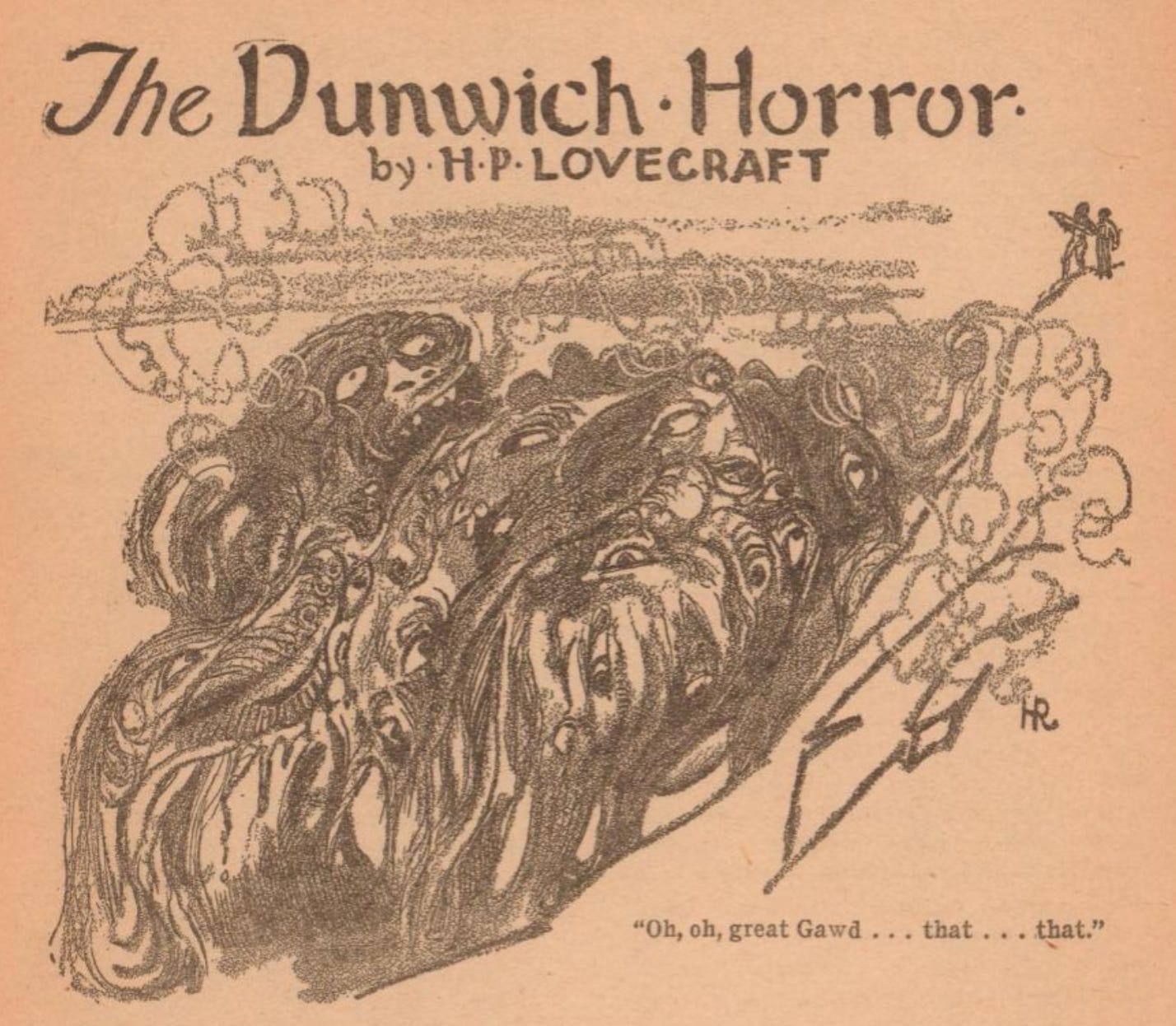
I stare at it for a long time.
What in the world is that?
I light a cigarette and sit on the edge of the bed. First drag slow. Then I start reading.
I read steady. Page after page. When I want air, I try to crack the window, but it sticks like it always does. I let it be. The room stays close.
Then I reach the story’s namesake.
“Bigger’n a barn . . . all made o’ squirmin’ ropes . . . hull thing sort o’ shaped like a hen’s egg bigger’n anything, with dozens o’ legs like hogsheads that haff shut up when they step . . . nothin’ solid abaout it—all like jelly, an’ made o’ sep’rit wrigglin’ ropes pushed clost together . . . great bulgin’ eyes all over it . . . ten or twenty maouths or trunks a-stickin’ aout all along the sides, big as stovepipes, an’ all a-tossin’ an’ openin’ an’ shuttin’ . . . all grey, with kinder blue or purple rings . . . an’ Gawd in heaven—that haff face on top! . . .”
Excerpt from The Dunwich Horror (1929) by H. P. Lovecraft.
I stop.
I flip back to the illustration.
I stare at it again.
Oh.
I get it now.
I flip forward and read that part again, slower.
The cigarette burns down. The ash grows long and I tap it off into the tray.
The story keeps going past that scene. I keep reading. When I reach the end, the cigarette is almost gone too. I take one last pull and stub it out.
I sit there for a minute with the magazine in my lap.
Then I look toward the window, toward the direction of the river.
That is terrifying.
After a minute I pick the magazine back up and turn the page into the next story.
Nearly a century later, it is a Saturday night and we are walking back from campus close to midnight.
We have been playing Magic: The Gathering for hours. Cards spread across a borrowed table. Laughter too loud for the hour. The usual ritual on the walk home, recapping the best plays, arguing about a missed trigger, promising one more game next week. Cold air. Streetlights. The long stretch back to the apartment complex.
We all lived on the first floor of the same place. Different rooms. Same thin walls. Same shared kitchen. Same worn carpet that remembered every late return.
Inside, we drift to our corners.
My room faced an open field. Wooden crossbars cut the window into uneven squares. I used to lie there and stare through the windows.
I pull out my phone and find the audiobook on YouTube. Not just anything. The Dunwich Horror. I cast it to the old television. The heavy one. The bright one. The one that hummed faintly when it warmed up. I keep the volume low. I want the words more than the performance.
I fall asleep to it.
Then I wake because the words cut through. Half dream, half conscious. The screen still glowing. The room washed in blue light. I must have slept like that all through college, too much brightness, drifting in and out while stories continued without me.
The monster scene is playing.
I do not roll over. I rewind. I listen again. I lean closer, as if the sound itself might sharpen the image. I rewind again. I want to see what the words are building.
The same instinct.
The dock worker bent over a pulp magazine, cigarette burning low, flipping back to the illustration, rereading the description to make sense of the thing in his mind.
Me, dragging a digital bar backward with my thumb.
I pause it. The screen goes black and throws my reflection back at me for a second before it disappears.
Different century. Same move.
He chose his story from a rack and carried it home under his arm after a shift at the docks.
I walked back from campus under streetlights and summoned mine from a server farm without leaving my bed.
Same hunger.
Different world.
I listened to the Dunwich Horror narrated by Horrorbabble on Youtube. I once went on a spree of Lovecraft stories by them and had strange dreams. I mostly remember seeing body horror of things once human. I still listen to Lovecraft's collaborations sometimes, but I try not to fall asleep.
Beautifully written